What do superteams do differently, and how does it become routine in everyday teamwork?
Top performance is a matter of habit. What matters is where these habits are anchored in the everyday work of teams.
Robert Wreschniok, TATIN Institute for Strategy Activation · 23 November 2026 · 5 min read
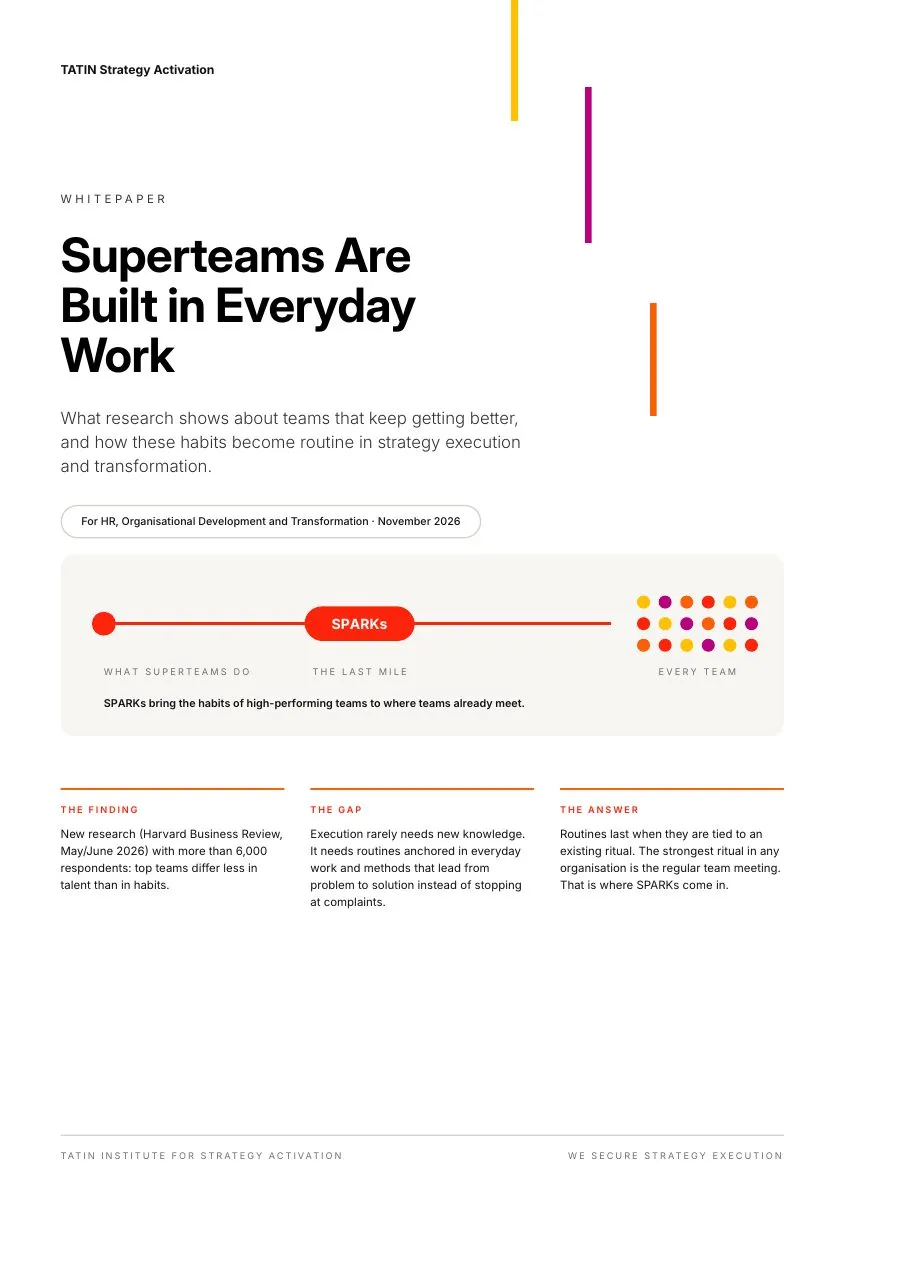
In Harvard Business Review (May/June 2026), social psychologist Ron Friedman reports on a survey of more than 6,000 knowledge workers. His finding: teams with outstanding performance differ less in talent than in habits. The TATIN Institute whitepaper shows why this insight alone does not change a team, and how it becomes routine in the regular team meeting.
- Superteams experiment around 50% more than other teams.
- Execution rarely lacks knowledge. It lacks routines in everyday work and methods that lead from problem to solution.
- Routines last when tied to an existing ritual. The strongest ritual in any organisation is the regular team meeting.
- In one practical example, the share of actions reducing complexity at team level rose from 9.7% to 58.3% in six months.
What did Ron Friedman study?
Ron Friedman studied what teams with outstanding performance do differently from other teams. He does not ask who works in top teams, but how these teams work together.
The results were published in the May/June 2026 issue of Harvard Business Review under the title “How to Build a Superteam That Keeps Getting Better”. They are based on a survey of more than 6,000 knowledge workers who rated the performance of their team.
Source: Friedman, Harvard Business Review, 2026. The figures describe correlations between behaviour and self-rated team performance.
Which seven habits set superteams apart?
Friedman condenses his findings into seven principles. None of them requires exceptional skill; all describe how a team organises its everyday work.
- Experiment moreQuestion even processes that work.
- Make curiosity contagiousAsk questions and admit gaps in knowledge.
- Surface obstacles openlyUse meetings for problems, not for status.
- Roll up your sleevesStay close to the work without micromanaging.
- Feedback that supportsTreat mistakes as learning opportunities.
- Foster growthSupport development, even without immediate benefit.
- Meaning before metricsShow the larger contribution of the work.
Why is knowing about superteams not enough?
Execution rarely needs new knowledge. It needs routines anchored in everyday work and methods that deliver both problem and solution.
Many formats make problems visible and stop right there. Then it ends in complaining, and week after week the urgent beats the important. Jeffrey Pfeffer and Robert Sutton described this pattern as the knowing-doing gap: organisations know what should be done, and still do not do it. Execution only happens when a team turns a named problem into a concrete next step, in hundreds of teams at the same time.
Why is the regular team meeting the best place for strategy execution?
Routines take hold sustainably when they are tied to rituals, that is, to practices already firmly established in the rhythm of team life. The largest ritual, established in every modern organisation, is the regular team meeting.
The regular meeting happens anyway, in every team, at every location, week after week. That makes it the place with the greatest lever for turning strategy execution and transformation into routine. Friedman’s data show the same from another angle: superteams use their meetings to make obstacles visible early instead of only reporting status.
How does a SPARK work?
A SPARK is a ritual of around 20 minutes within an existing regular meeting. In three steps it leads from a question to a concrete action; the impact is checked afterwards.
- ShareA curated question, derived from the agreed goals, brings all perspectives to the table. Everyone answers simultaneously and anonymously.
- FocusThe team chooses a shared focus that it can influence itself.
- ActThe team agrees one concrete action with an owner and a deadline and links it to a goal.
- AnchorA few weeks later the team checks the impact and decides: keep, adjust or move to the next SPARK.
Where does the approach go beyond Friedman’s research?
Friedman describes the individual superteam. Organisations executing a strategy or transformation need four extensions.
What impact shows up in practice?
In one project, all teams had clarified their contribution to success, yet only 9.7% of the actions developed dropped something in return. With the SPARK “Far too much energy for too little impact”, after six months 58.3% of actions aimed at reducing complexity at team level, without the teams losing sight of their goals.
Source: impact data from projects of the TATIN Institute for Strategy Activation. The 12.7% is a calculation model (1.01 to the power of 12) with a deliberately minimal assumption.
What do team leads, teams and senior management gain?
What is in the whitepaper?
- What Ron Friedman studied and how robust the data are
- The seven habits of teams that keep getting better
- Three ways the research confirms practice
- Why routines need rituals and the regular meeting is the greatest lever
- The SPARK cycle with Share, Focus, Act and Anchor
- The practical example “Energy flows where focus goes”
- Five questions to assess your organisation
Frequently asked questions
- What is a superteam?
- According to Ron Friedman (Harvard Business Review, 2026), a team with outstanding performance that keeps improving. It differs less in talent than in habits: more experiments, obstacles raised early, mistakes treated as learning opportunities and a clear sense of the meaning of its work.
- What is the SPARKs method?
- A method developed by the TATIN Institute for Strategy Activation that anchors strategy and transformation in the everyday work of teams: around 20 minutes in an existing regular meeting, with question, focus, action, owner and impact check.
- Does Friedman’s research prove that SPARKs work?
- Friedman’s research describes which behaviours set high-performing teams apart. SPARKs anchor exactly these behaviours in everyday teamwork. Whether they take hold in an organisation is shown by ongoing impact data, month after month.
- Is this a surveillance tool?
- No. Contributions are anonymous and cannot be traced to individuals. Analyses are only aggregated across at least five team leads.
- How often should a team run a SPARK?
- Once a month already makes a noticeable difference. What matters is that it happens regularly.
- How do I get the whitepaper?
- You can download it here directly as a free PDF.
Superteams are built in everyday work. Where teams already come together.
Download the whitepaperPDF, 9 pages, free of charge
Robert Wreschniok
CEO and founder, TATIN Institute for Strategy Activation. Since 2011, the TATIN Institute has supported organisations on the last mile of strategy execution. A project with E.ON Italia was recognised by the Stanford Social Innovation Review in 2025.